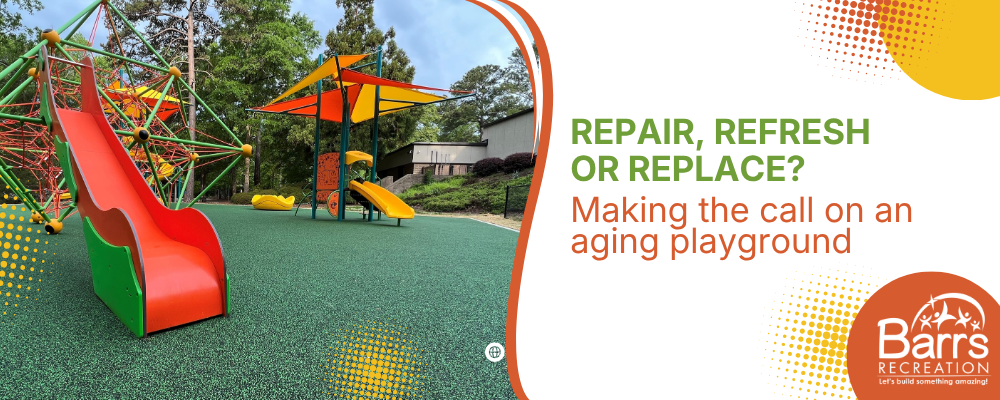
A lot of the Carolinas' playgrounds are now past the twenty-year mark. They've held up through years of after-school crowds and summer camps, and they've reached the age where it pays to look hard at what comes next. There are three good moves: repair the playground, refresh the worn parts, or plan a full replacement. Which one is right comes down to what the equipment is telling you.
The best time to take stock is when your season slows enough to plan. You can see how each piece held up over the year, and there's room to work things out before the next inspection cycle and budget round.
How long does playground equipment last?
Material gives you a rough guide, and warranty terms put real numbers behind it. Barrs carries two product lines, and both have stood behind their equipment for decades.
BCI Burke®'s Generations Warranty® covers the steel and aluminum posts for a hundred years, decks and plastics for fifteen, and moving parts for five. Berliner is built on the same idea. Manufacturing a select line of equipment in Greenville, South Carolina, it carries a lifetime limited warranty on its steel support posts and fifteen years on its steel components. Its rope is closer to a cable than a cord, a nod to the company's roots in elevator-cable manufacturing.
Typically, the frame outlasts the parts bolted to it, and the moving parts wear out first. That's why an install date tells you so little on its own. One playground often carries several different ages at the same time.
Upkeep is also a factor. A well-kept steel frame outlasts its plastics twice over, and steady maintenance holds a structure solid well past its warranty dates. So the real question isn't age. It's whether routine upkeep still does the job, or whether it's time for a bigger call.
A few signs point to the answer:
-
The same part keeps landing on your repair list.
-
Corrosion is working into the footings and welds.
-
Replacement parts are getting harder to track down.
Start with a certified inspection
Your crew's routine inspections, the daily visual checks, and the periodic hardware and surfacing reviews are built for a different job than the refresh-or-replace question. That question calls for a full inspection against current standards.
A Certified Playground Inspection Report is a one-time, top-to-bottom evaluation of the whole playground. A Certified Playground Safety Inspector (CPSI) carries it out, measuring the site against the current ASTM F1487 standard and CPSC guidance. The inspector checks every component with probes and gauges, rates each finding by priority, and hands back a clear roadmap: what to address now, what can wait, and what has run its course.
Barrs Recreation can coordinate it all. Barrs keeps CPSI-certified inspectors on staff, requires its installers to hold the credential, and brings in third-party inspectors when that's the better fit. The report comes back documented with photos and a plain list of findings, so it makes the repair, refresh, or replacement call for you and backs a budget request when you take it forward.
When does a refresh make sense?
Sometimes the bones are fine, and only the worn pieces need attention. A refresh is parts replacement: a new slide or deck surface, updated panels, a fresh climber in place of a tired one, or a ramp and transfer point that brings an older structure up to today's accessibility expectations. It's the right move when the posts, frame, and footings are sound, and the parts you need are still made.
You can also add or swap freestanding pieces and refresh the surfacing to give a playspace a new feel without touching the main structure. That's a useful bridge when a full replacement is a few years out. It keeps the space engaging now and buys time to fundraise toward a new main structure in the next two to five years.
Parts availability depends on the manufacturer. Because Burke controls its own manufacturing, replacement parts stay available years down the line, so an older Burke frame is often a strong candidate. Berliner's rope play works the same way. If one rope wears out, you replace that rope instead of the whole net, which can save thousands. So don't count a structure out too soon. Ask your rep what can still be sourced for it.
When is replacement the smarter investment?
Replacement makes more sense in a few situations. The clearest is a frame and footings that have reached the end of their run, or a job where bringing the playground up to current standards would mean rebuilding most of it anyway. It's also the practical call when parts are no longer made, or when a few years of repair costs would have carried you most of the way toward something new.
One more reason has nothing to do with condition. Sometimes the play value no longer fits the community. A structure built for two to five-year-olds in a neighborhood now full of nine and ten-year-olds isn't failing. It has just grown up with a different crowd than it was built for, and replacement is your chance to match the equipment to the kids who actually show up.
Replacement doesn't have to strain the budget. It rarely means a full public bid, and cooperative purchasing contracts or grant funding can each reduce the number. It's worth asking your rep early what your project qualifies for.
Making your case
Walk into the budget conversation with the inspection report, the priority ratings, a note on parts availability, and a simple tally of recent repair costs. Documentation turns your judgment into a request that the people holding the budget can act on.
Have a structure you're weighing? Barrs Recreation's Certified Playground Safety Inspectors can inspect it and lay out your repair, refresh, and replacement options with real numbers behind each. Reach out to your Barrs Recreation representative or email [email protected] to get one on the calendar.