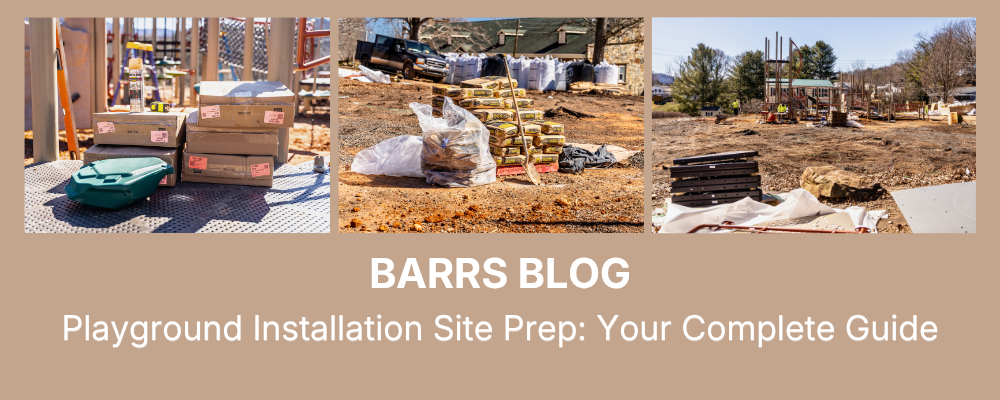
Your Complete Site Preparation Guide
A little preparation before your installation date goes a long way. Knowing what to expect and having the right things in place keeps your project on schedule and on budget and makes the whole experience smoother for everyone involved.
This guide walks through everything to have ready before our Barrs crew arrives.
Grading: Getting The Ground Ready
Your site doesn't need to be perfectly flat, but it does need to be within a 1% grade to meet compliance standards. Your Barrs representative will assess this during the site visit and walk you through whether any excavation is needed.
If grading is required, here's a simple way to keep costs down: designate a spot on your property for the excavated material rather than having it hauled away. That alone can save a meaningful amount.
Also, if there's any chance your site has rock below the surface, let your rep know early. Rock discovery during installation adds labor and time, and those costs fall outside your original project quote. Getting ahead of it gives everyone a chance to plan accordingly.
Drainage: Address Before Installation
Standing water on a playground accelerates the deterioration of every surfacing type. If your site is prone to flooding or has poor drainage, addressing it before installation is a worthwhile upfront investment.
Water should flow away from the play area. A good way to check: walk your site after the next heavy rain and see where water collects. In the Carolinas, having drainage considered before summer rather than after is always the better call.
Utilities: Call 811, Then Tell Us About the Rest
811 is the free, federally designated “Call Before You Dig” service. Before any digging begins, a request is submitted through 811, and utility companies send locators to your site to mark underground public lines—gas, electric, water, and telecom—with flags or paint. Barrs Recreation and its installers coordinate and handle all public utility line markings as part of the installation process.
Customers are responsible for identifying and marking any private lines on their property. This includes secondary water, sewer, gas, electrical, irrigation, and any other privately run lines, which will not appear on an 811 request. Property owners must identify these lines and communicate their locations to the Barrs crew before any work begins.
If you’re unsure what lies beneath your property, it’s important to locate that information before your installation date. Having this information ready at your site visit helps keep the project on schedule and avoids delays.
Access: Plan for the Equipment Delivery
Equipment arrives on long pallets up to 14 feet long via freight truck. Having a clear path from the delivery point to the installation area makes a real difference on day one.
Good access typically means double-wide gates, a clear route that minimizes travel across existing concrete, and a designated staging area. If your site has a narrow entrance or obstacles between the delivery point and the play area, bring them up during the site visit. Your representative will work through the logistics with you so there are no surprises on installation day.
Fencing: Get the Sequence Right
Fencing around playgrounds has become increasingly popular, and for good reason. The key is timing. Fencing should go in after the playground installation is complete, not before.
Having fencing already in place limits crew access and makes it significantly more difficult to get equipment to the site. This can also make surfacing installation more difficult and costly. Plan to schedule both fencing and surfacing as follow-up work once the playground installation is complete.
If you’d prefer to keep it all under one contract, Barrs can include both fencing and surfacing in your scope of work and schedule them in the proper sequence.
The same goes for sod and landscaping. Get the playground in first, then bring in the finishing touches around it.
Site Security During Installation
If your site is in a high-foot-traffic area, it's worth discussing overnight security with your rep during the installation window. Security is not included in the base cost of your playground unless it's specifically discussed and added to your agreement.
One of the best ways to minimize concerns is to have your site fully ready when the crew arrives. A job that starts on time moves faster, which means less time spent staging equipment between installation days.
Questions to Have Ready for Your Site Visit
Your representative will cover all of this in person, but coming prepared makes that conversation more productive. Before that meeting, it helps to know:
-
Has the site been graded, and do you have a sense of the current slope?
-
Does the area drain well after heavy rain?
-
Are there any private utility lines on the property — irrigation, secondary electric, or others not covered by 811?
-
What access points are available for a freight delivery?
-
Is fencing planned? If so, who's handling it, and when?
Get those answers lined up, and your installation will start from a strong position.
Ready to get your project moving? Learn more about the Barrs Recreation planning process or reach out to your representative to schedule a site visit.